Project Description
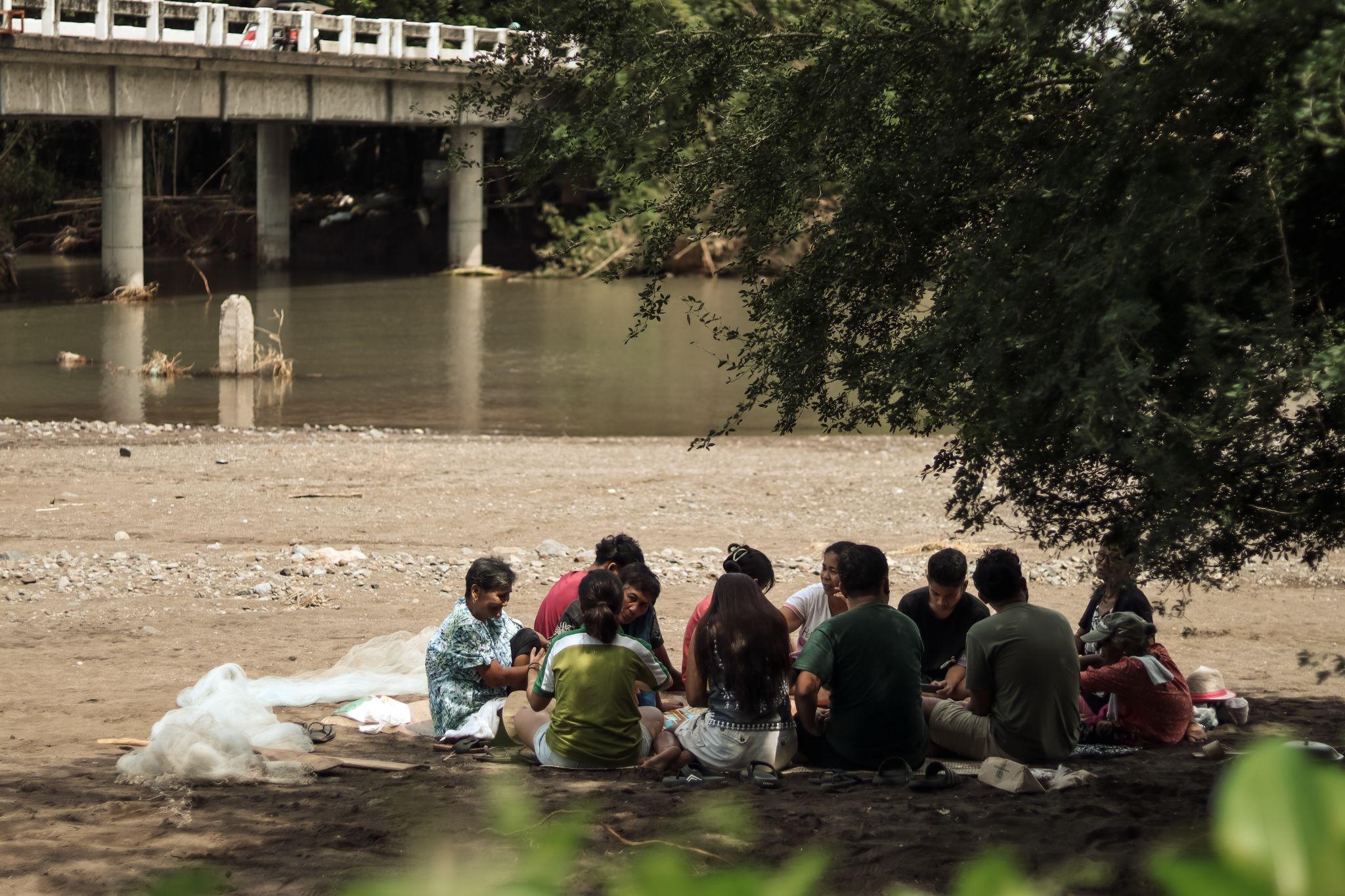
Ambient Narratives attempts to surface tensions between climate, development, and memory through art and public dialogue, which are crucial in a context where decision-making often excludes those most affected. Using sonic knowledge, Ambient Narratives tells the story of a changing landscape in the typhoon belt, listening to how people and more-than-human voices adapt, resist, and reimagine resilience in a climate-vulnerable Philippines.
Through dialogues and deep listening interventions, we trace the ilaya (upstream) to ilawod (downstream), both sites marked by sea-level rise, climate grief, and biodiversity loss. The work culminates as a sound archive, mobile and online exhibits, and community assemblies, where rural voices interrogate climate narratives in formal spaces. Carrying fragments of memory, testimony, and everyday adaptation helps this project position sound as a living archive and insists that local actions are global acts of resistance. The site is a field of interrogation; this work is being created in the context of corruption of public funds for climate adaptation, human rights abuses against environmental defenders, land dispossession, and the steady march of corporate and dynastic looting of our commons.
Ambient Narratives attempts to surface tensions between climate, development, and memory through art and public dialogue, which are crucial in a context where decision-making often excludes those most affected. We attempt to gather and make sense of these shifts through collective articulations, interruptions, and everyday adaptations that are rarely counted in climate discourse. Using sonic knowledge, this work tells the story of a changing landscape in the typhoon belt, listening to how people and more-than-human actors adapt, resist, and reframe resilience in a climate-vulnerable country.
Bio of Awardee/Organization
Tonio Flores II is a Filipino land worker, researcher, and artist. His work is focused on urban and rural entanglements, land, commodity histories, and food (how it forms and revises landscapes, territories, bodies, and beliefs). He investigates these impulses through image, sound, text, performance, placemaking, and action research. He is a research fellow at Critical Pathways at Utrecht University, where he centers a participatory and affective inquiry on local food systems. Flores has done residencies at PACT Zollverein in Germany and Casco Art Institute: Working for the Commons. He is a YSEALI Fellow on Environmental Issues and Natural Resource Management at the University of Montana. e-based learning.
Ekopraxis Pilipinas & Dulungan Youth are a group weaving together community organizing, artistic practice, participatory and regenerative design in the Philippines. Our work is a direct response to the ongoing shift to authoritarian, corrupt, and neoliberal leadership in the Philippines, as well as the constant erosion of cultural and environmental knowledge in rural areas due to globalization and the corporate capture of food systems.
We respond by centering creative, rights-based, grassroots, queer, and feminist worldmaking to make our movements stronger and to better push back against oppressive state and market forces. Our work spans agroecology, biodiversity protection, tech equity, cultural organizing, and climate education. We’ve led mutual aid networks, co-developed learning programs, and supported community partners in building just-food and climate-justice actions.
Our work is a political and deeply personal commitment to confronting the systems that exploit people, land, and culture, especially in the Global South. It’s about building bottom-up, intersectional movements that center the wisdom and leadership of communities who have long resisted colonial, capitalist, and technocratic harm. These communities, informal workers, youth, farmers, queer people, and local communities have always held the solutions to the climate crisis, even as they’ve borne the brunt of its impacts.
Jury Report
Ambient Narratives proposes to trace a river in rural Antique from ilaya (upstream) to ilawod (downstream) and toward a sinking island. The project by Tonio Flores II, Ekopraxis Pilipinas, and Dulungan Youth gathers the sonic dimensions of a place living under compounded pressures: sea-level rise, biodiversity loss, the corruption of public funds designated for climate adaptation, human rights abuses against environmental defenders, and land dispossession. The proposal names these conditions, and the committee found that naming them was necessary. Sound, in this project, is positioned as a form of knowledge, and local acts of listening, as the proposal argues, are global acts of resistance.
The archive’s design moves in two directions. Upstream, the project gathers the memories of a community standing between an old handmade wooden bridge—built through collective necessity—and a new one entangled in what the proposal calls “development aggression” and the infrastructure obsessions of foreign loans. Downstream lies an unmarked history: the site where five hundred townspeople resisted the political repression in the 1980s, and where no memorial stands. Ambient Narratives intends to surface these layered memories through dialogue, field recordings, and a proposed counter-memorial — not as a heritage exercise, but as a continuation of the resistance. The committee recognized in this structure a project that holds ecological and political memory together without flattening either.
The project’s thinking about audience and collaboration also drew the committee’s attention. Rural working-class communities are positioned as co-creators—their narrations shaping the form of the work, their contributions acknowledged and remunerated. The mobile exhibit is designed to travel to galleries, educational institutions, and climate justice forums, including COPs—carrying local articulations into spaces where they are seldom heard. The committee also noted the writing of the proposal itself: accessible and grounded, communicating urgency without requiring the reader to already speak the language of climate discourse. The TAWID Grant functions as a bridge, and Ambient Narratives is work that needs one: rooted in a landscape that is changing faster than it can be recorded, and committed to making that record in community, from the ground up.
Pictures
Photos will be shared shortly.