Due to unforeseen circumstances, the project was unable to proceed.
Project Description
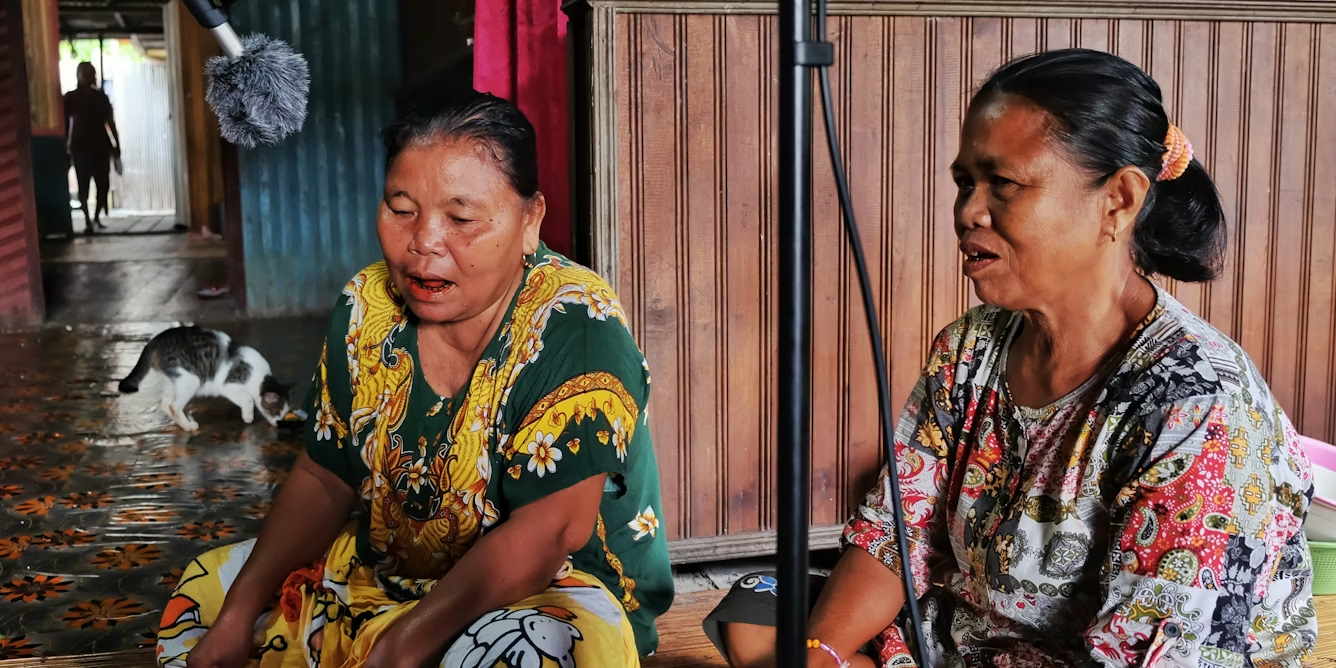
Ritual Archives of the River: Recording and Reconnecting the Sonic Ecologies of Sasana Kayau in Katingan Awa is a collective sound archiving initiative in Central Kalimantan, Indonesia. Led by ethnomusicologist and sound artist Muhammad Rayhan Sudrajat, the project approaches Sasana Kayau, a ritual vocal form performed in Dayak Katingan gatherings, as relational knowledge: a living interface where song, speech, river, forest, and ancestral worlds co-produce meaning and care.
Its ethics are governance-based. Recording and circulation follow community consent; files are co-curated with local participants, annotated and named in the Katingan Dayak language, and returned in accessible formats. Copies will be stored locally on a community hard drive and, where desired, shared through a secure online repository accessible only to participants.
During a fieldwork week along the Katingan River, Sudrajat will record Sasana Kayau performances, oral narratives, and environmental soundscapes, alongside interviews that situate each piece within ritual function, cosmology, and environmental symbolism. A communal listening session will convene elders and youth to playback, comment on, and collectively reinterpret the recordings, strengthening transmission while the community decides what is remembered and how it travels.
Outputs include a small community sound archive of 5–10 high-quality recordings, the local-plus-secure copy repository, documented reflections (short video/audio), and a written report with sound notes for the Sonic Entanglements platform.
By foregrounding ritual sound as ecological knowledge amid peatland degradation and climate pressures, the project advances the Tawid Grant’s vision to support small-scale, grassroots archives that reconnect sonic heritage with source communities through decolonial, care-based practice.
Bio of Applicant/Organization
Muhammad Rayhan Sudrajat is an ethnomusicologist, sound artist, and lecturer in Sound Arts and Public Speaking at Universitas Katolik Parahyangan (UNPAR), Bandung, Indonesia. His research explores the intersections of ritual sound, ecology, and digital culture in Indonesia, with a particular focus on the Dayak Katingan Awa community in Central Kalimantan.
He holds a Master of Arts (by Research) in Ethnomusicology and Musicology from Monash University, Australia (2020), where his thesis, The Function and Meaning of the Gandang Ahung in the Hindu-Kaharingan Religion and Ritual of the Tiwah amongst the Katingan Awa, served as the foundation for his ongoing fieldwork. His scholarly and creative practice integrates ethnographic documentation, ecoacoustic methods, and community-based sound art.
Rayhan has published articles on Kalimantan sound traditions in The Conversation Indonesia and has performed internationally under the name Rohelok, a project blending traditional and electronic music. His work is grounded in long-term collaboration with indigenous communities and in a belief that sound functions as both evidence and care in sustaining cultural and ecological futures.
Jury Report
The selection committee selected the Katingan Project because it understands the archive not as a container, but as a form of relation. In this proposal, recording becomes a way of staying with what is already there: ritual performance, spoken knowledge, and the river’s own acoustic presence. The committee was persuaded by how the project frames archiving as a participatory act of remembrance and resilience, a practice meant to be carried by the community rather than extracted from it.
What makes the proposal convincing is its balance of thought and method. It sets out a clear sequence of actions that remain proportionate to the grant while still holding depth: documenting Sasana Kayau performances and their narratives, paying attention to the ecological sound conditions around the Katingan River, and building an archive that can be accessed locally while also secured through a digital repository. The committee recognized in this structure a careful insistence that sound documentation must not float free of context, and that the meaning of what is recorded emerges through situated listening and shared interpretation.
The committee also noted the project’s collaborative ethic, especially the emphasis on intergenerational exchange. The proposed listening session, bringing elders and younger participants into the same space of audition, was understood not as an output but as a hinge, where documentation turns into transmission. This is where the archive becomes living: through collective annotation, local naming, and the deliberate re-embedding of recordings into community knowledge practices. The committee appreciated that the proposal’s language is explicit about responsibility, consent, and co-curation, and that it signals a long-term orientation rather than a one-off capture.
Finally, the committee’s decision was strengthened by the project’s urgency without spectacle. The committee returned to the stakes of environmental vulnerability and ongoing ecological destruction, and how river, forest, and ritual sound are not merely aesthetic materials but traces of a threatened continuity. The proposal’s feasibility, clarity of staging, and fit with Tawid’s intent made the choice decisive: this is a project that treats sound as a bridge between past and present, between community and environment, and between what can still be heard and what must be cared for so it remains hearable.
Due to unforeseen circumstances, the project was unable to proceed.