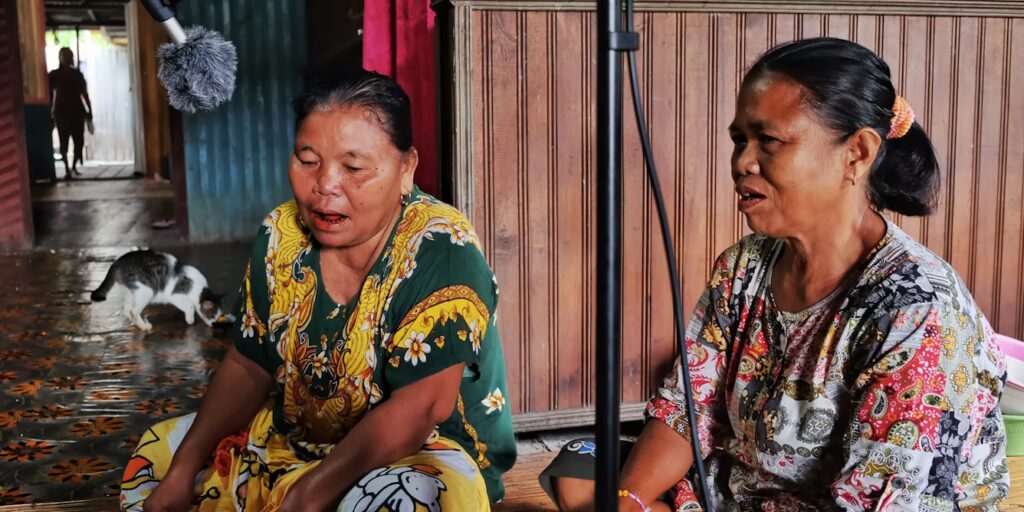
This year’s selection committee understands “diversity” in Tawid not as a tally of flags on a map, but as a commitment to plural communities, plural histories, and plural forms of sovereignty that often predate, exceed, or sit uneasily within the neat borders of “nation” and “region.”
In the deliberation, the committee returned to how Southeast Asia is frequently reduced to a narrow geopolitical imagination, and how even frameworks like ASEAN can flatten the complexity of autonomous regions, contested political identities, and local worlds that do not fit dominant categorizations. From this perspective, two projects located in Indonesia can still embody substantive diversity: not only of language, ecology, and cultural practice, but also of who gets to narrate, name, and govern what an archive is.
Tawid’s other axis of diversity is structural: who has access to resources, and who is routinely left outside funding circuits. The committee emphasized that the grant is designed to plant seeds for grassroots initiatives, especially for people and communities with limited access to support, so as to avoid reproducing the “Matthew effect,” in which those who have already received funding continue to receive more. In weighing the selection, the committee considered urgency as well as equity: the two selected proposals speak to pressing conditions, and they do so with clear, community-accountable methods. The committee therefore awarded both recipients not to make a statement about a single country, but to follow Tawid’s intention, to channel modest resources toward projects where they can materially shift capacity, sustain local knowledge, and strengthen community agency at the point of practice.
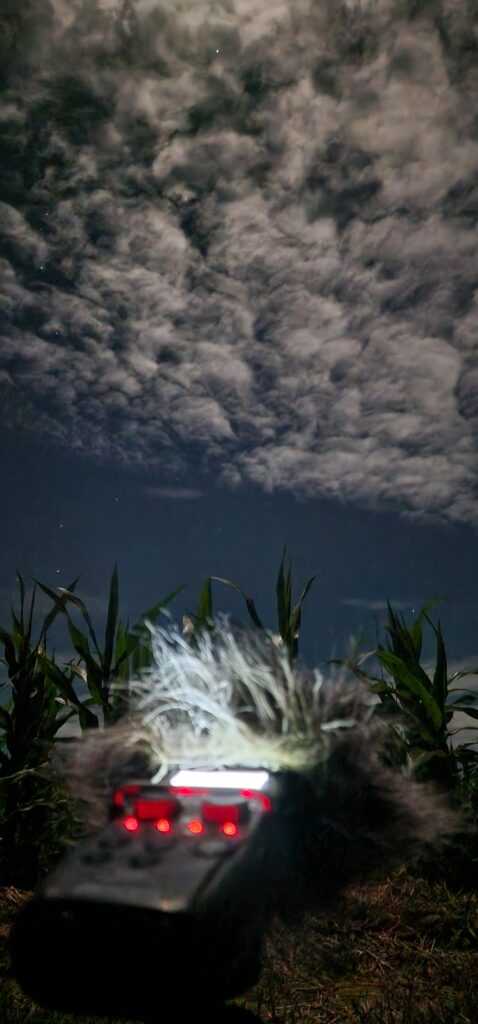
In 2025, the Tawid jury carefully reviewed a wide range of proposals and selected two projects that stood out for their clarity of purpose and deep community grounding.
The two awardees, both based in Indonesia, celebrate archiving as a living practice shaped by relationships, responsibility, and care. Community Sound Archive of Yokiwa (Sentani, Papua) builds a locally governed collection of soundscapes and akhoykoy oral knowledge, pairing recording and curation with soundwalks and youth skill-sharing. Ritual Archives of the River (Katingan River, Central Kalimantan) documents Sasana Kayau as river-based ritual knowledge through consent-led recording, local-language annotation, and intergenerational listening, with materials returned to the community through locally held storage and a participant-only repository.
Warm congratulations to both awardees for these vital projects, and for the generous futures of listening they help make possible.
Community Sound Archive of Yokiwa
In Yokiwa Village, Sentani (Papua), the clans Awoitauw, Fiobetauw, and Mimitauw sustain akhoykoy, a folklore tradition carrying ecological ethics, cosmological understandings, and teachings on land stewardship. Alyakha Art Center Foundation and Nafas Danau Sentani Arts Collective have worked with clan leaders and local youth to record Yokiwa’s soundscapes and oral narratives. These materials remain unorganized amid ecological pressure and the risk of losing oral knowledge.
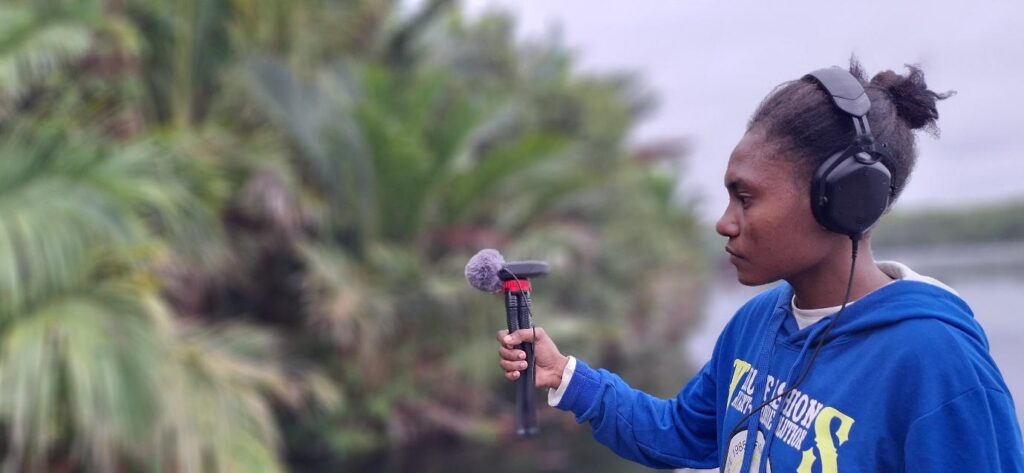
The young generation of Yokiwa Obed Fiobetauw and Gloria Monim villages learn to do field recording in the customary forest area.
Ritual Archives of the River
Due to unforeseen circumstances, the project was unable to proceed.
Ritual Archives of the River: Recording and Reconnecting the Sonic Ecologies of Sasana Kayau in Katingan Awa is a collective sound archiving initiative in Central Kalimantan, Indonesia. Led by ethnomusicologist and sound artist Muhammad Rayhan Sudrajat, the project approaches Sasana Kayau, a ritual vocal form performed in Dayak Katingan gatherings, as relational knowledge: a living interface where song, speech, river, forest, and ancestral worlds co-produce meaning and care.